
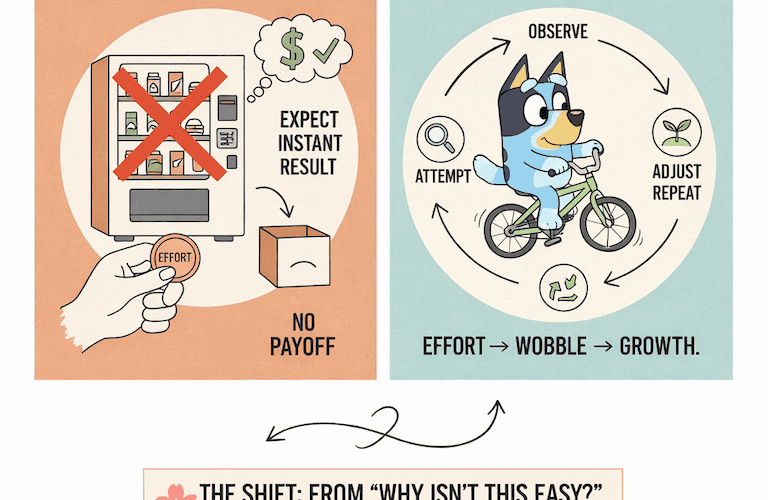
Bluey’s “Bike”: Why Persistence Is Built in the Messy Middle
There’s a reason Bluey lands so hard with adults. The show slips grown-up truths into ordinary moments — and “Bike” might be one of the clearest examples of how real growth actually works.
This episode isn’t about winning. It’s not about talent, confidence, or getting it right the first time. It’s about the unglamorous middle: the wobble, the sigh, the quiet frustration, and the decision to try again anyway.
As I talk about in my Pop Culture Therapy pillar post, we don’t watch stories like this just for entertainment. We watch them to relearn lessons we absorbed too early — or skipped altogether. “Bike” doesn’t teach persistence with speeches. It models it, scene by scene, through effort that looks ordinary until you realize how rare it is.
The Episode, Up Close: Persistence in Motion
The episode opens at the park. Bluey tries to ride her bike. She pushes off, wobbles, falls. She drifts back to the bench where Bandit is sitting, asking the question most of us still ask as adults: Why isn’t this easier by now?
Bandit doesn’t rush in to fix it. He doesn’t correct her form or offer shortcuts. Instead, he creates space — and gently nudges her to notice something important: everyone around her is struggling with something too.
That small parenting choice sets the tone. What follows isn’t a lesson — it’s observation.
Bingo vs. the water fountain
Bingo wants a drink, but the fountain is too high. She presses the button, water spurts out, and she can’t reach it in time. She tries again. Same result. Nothing about the setup changes — except her approach. Eventually, she figures out a workaround: letting the water overflow so she can drink from what spills. It’s not elegant. It’s effective. And it works because she keeps experimenting.
Bentley vs. the monkey bars
Nearby, Bentley keeps jumping for the first rung. She misses again and again. Her legs don’t suddenly grow longer. What changes is her calibration — timing, effort, commitment. The animation lingers on the repetition: jump, land, reset. Incremental progress. Honest effort.
Muffin vs. the backpack
Then there’s Muffin, locked in battle with a too-big backpack. Straps twist. Arms tangle. Momentum stalls. No adult steps in to “just do it.” Muffin wrestles with the problem until it finally clicks. It’s mundane and quietly triumphant — exactly how persistence usually looks.
While all of this unfolds, Bluey watches. And that’s the point. No one motivates her with words. She absorbs the lesson by witnessing effort in progress — not mastery, not success, just refusal to quit.
When she tries again, it’s modest: a steadier push, a few more pedals, a brief glide. Not a breakthrough — a belief shift. From “I can’t” to “maybe I can.”
That’s the soul of “Bike.” Growth doesn’t arrive as a leap. It arrives as permission to try again.
Why This Episode Hit Me
For a long time, I confused failure with finality. If something didn’t work — plan A, B, or C — I shelved it and moved on. Not because I didn’t care, but because persistence felt risky. Like doubling down on disappointment.
But anything we’re good at now exists because we persisted once without labeling it that way. Learning to walk. Learning to speak. Learning to balance. We fell constantly — and never once treated it as a verdict.
Somewhere along the line, adulthood taught us to interpret the same fall as evidence we should stop.
Watching “Bike” reminded me how often I treat goals like vending machines: insert effort, expect result. When nothing drops, I walk away annoyed instead of adjusting the approach. Persistence isn’t stubbornness. It’s flexibility paired with commitment.
As a mother watching this with my daughter, I realized I was often rushing her through the wobble because I was still trying to avoid my own.
The Lesson Worth Keeping
Progress beats perfection. Small wins count.
No one in this episode gets magically better. They solve problems through micro-adjustments — the kind we usually edit out of our personal narratives because they feel unimpressive.
But effort compounds. And movement — even awkward movement — rewires belief.
When work feels tense, when creative projects stall, when life feels loud and unsteady, I don’t need a clean slate. I need traction. A foothold. Proof that effort still adds up.
How I’m Applying “Bike” Right Now
-
Shrink the goal.
“Launch the business” becomes “rewrite one paragraph.”
“Be consistent on YouTube” becomes “film a 20-second hook.” -
Reward the attempt.
Showing up counts — even if the result isn’t clean yet. -
Borrow belief from effort, not outcomes.
Watching others in their messy middle is fuel. Drafts, tests, quiet iterations — that’s where progress lives.
What Persistence Actually Looks Like (Not the Instagram Version)
It looks like reopening a document you swore you were done with — and changing the first paragraph again.
It’s hitting record one more time even though your voice sounds tired and you’re already late.
It’s taking the quieter seat at work, doing your job well, and letting the work speak instead of forcing yourself into the noise.
It’s making the same recipe for the twelfth time because something still feels slightly off — and trusting that noticing the problem means you’re closer, not further away.
It’s posting even when nothing happens, choosing consistency over mood, and showing up without applause.
That’s “Bike.”
No highlight reel. No instant payoff. Just effort quietly doing its job.
This is how we stop [sabotaging our own peace]—by realizing that the ‘messy middle’ isn’t a sign that things are going wrong, but a sign that we are exactly where we need to be.”
Why We Stall — and How This Episode Nudges Us Forward
We stall because:
-
Fear pretends to be practicality.
-
Comparison kills momentum.
-
Early attempts feel clumsy — and clumsy feels unacceptable if your standards are high.
“Bike” answers all three. It normalizes awkward starts, strips progress of drama, and shifts focus from results to effort. Bluey isn’t inspired by someone cruising — she’s inspired by people still figuring it out.
That’s the shift most of us need.
A Simple “Bike” Practice You Can Use Anywhere
-
Name the bar.
What’s the first rung you can’t quite reach right now? -
Design the micro-try.
One sentence. One draft. One action you can repeat. -
Track the tiny win.
Don’t wait for perfect. Notice improvement.
If you want a mental cue, borrow the episode’s rhythm:
Observe → Attempt → Adjust → Repeat.
That’s not just the plot — it’s the blueprint.