
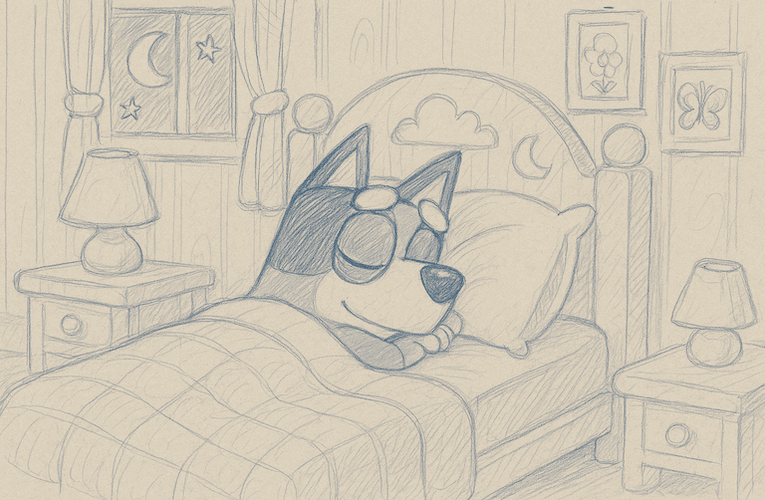
Bluey’s Sleepytime: The Bedtime Episode That’s Actually About Adult Life
Let’s be honest: parents and child-free adults don’t watch Bluey just because it’s cute.
We watch it because, somehow, this little animated show understands adulthood better than half the self-help books on our nightstands. And if the whole idea behind Pop Culture Therapy is finding pieces of our healing tucked inside the stories we watch, then Sleepytime is the episode that quietly proves the point.
It’s therapy disguised as a seven-minute kids’ cartoon.
It sneaks up on you.
And before you know it, you’re sitting there emotional over cartoon dogs — because it hits something real.
The chaos. The tenderness. The reminder that even when you’re running on empty, there’s still room for softness
1.The “Rewatch Reflex” (And Why We Keep Going Back)
In my Pillar Post on Pop Culture Therapy, I talked about why we’re drawn to familiar shows — especially when life feels loud or unstable. Psychologists might call it mere-exposure effect, but honestly? It’s simpler than that.
It’s comfort.
When real life feels like one long string of plot twists you didn’t sign up for, your brain just wants one place where it knows what’s coming next. Rewatching isn’t laziness. It’s your nervous system saying, I need a break.
Think of it like a mental weighted blanket.
No surprises. No suspense. Just something steady you can sink into.
That’s why bedtime routines matter so much. On paper, they sound calm and orderly: bath, pajamas, lights out. Very serene. Very aspirational.
But Sleepytime shows what bedtime actually looks like.
Someone suddenly needs water.
Someone’s wandering around half-asleep.
Someone’s snoring like they’re auditioning for a nature documentary.
That chaos inside the routine? That’s adulthood.
We spend so much time trying to create order — planners, schedules, goals, systems — and yet life keeps doing its thing anyway. Bluey gently reminds us that the point of routine isn’t perfection. It’s the comfort of returning to something familiar. To each other. Even when the plan completely falls apart.
And sometimes, that’s enough.
2. Re-Parenting the Need for Independence
When Bingo announces she wants to sleep in her own bed like a “big girl,” every adult feels that moment.
It’s that quiet pressure we put on ourselves to have it all together.
But here’s the inner-child truth hiding underneath it: being a “big girl” (or a capable adult) doesn’t mean you stop needing reassurance.
When Chilli says, “I’m here if you need me,” she isn’t just talking to a cartoon puppy. She’s talking to the part of us that’s scared to do life alone.
You’re allowed to be independent and supported at the same time.
3. Validation for the Burnout (You Aren’t Failing)
Bandit and Chilli get dragged through the night — kicked, nudged, half-awake, barely functioning.
And as adults, we’re quick to confuse exhaustion with failure.
If we’re tired, we assume we’re doing something wrong.
But Sleepytime gently flips that idea on its head:
You aren’t exhausted because you’re failing — you’re exhausted because you’re showing up.
Whether it’s work, money, caregiving, emotional labor, or just holding life together… burnout is effort, not incompetence.
4. The “Drift”: Navigating Adult Disconnection
In the dream sequence, Bingo drifts through the cold emptiness of space. She floats too far and loses her way.
That moment lands hard.
Because it’s not just a dream — it’s what burnout feels like.
You wake up one day and think, Who am I? How did I get here?
Stress pulls us away from ourselves. Responsibilities pile up. Identity gets blurry.
And then Bingo finds the Sun — her mother — and makes her way back.
The lesson: your “Sun” is whatever brings you back to yourself.
Faith. Creativity. Your partner. Your purpose.
It’s okay to drift — as long as you remember you have a way home.
5. Being the “Sun” While Still Needing Light
Chilli is shown as the Sun — steady, warm, constant.
A lot of us play that role in real life.
You’re the one who:
-
Manages family dynamics
-
Carries the emotional load at work
-
Holds it together for everyone else
But even the Sun has limits.
Pop Culture Therapy reminds us that being strong doesn’t mean being self-sacrificing to the point of depletion. You can be someone’s warmth and still need to be warmed.
Needing comfort doesn’t make you weak — it makes you sustainable.
6. Taking Space Without Losing Love
At the end of the episode, Bingo returns to her own bed — confident, safe, grounded.
Chilli stays close enough to be a safety net, but far enough to let Bingo grow.
As adults, we often feel guilty for needing space.
A night off. A boundary. Silence.
We worry that stepping back means losing connection.
Sleepytime shows us something gentler: healthy love doesn’t disappear just because you need to breathe.
How Sleepytime Heals Your Inner Child
If you find yourself getting misty during the final scene, don’t brush it off as “it’s just a cartoon.”
Something real is happening there.
You’re watching a kind of care, reassurance, and safety that maybe you didn’t always get — or didn’t get enough of. And for a few quiet minutes, you’re letting yourself imagine what it would have felt like to be comforted without conditions.
You’re seeing a parent who stays steady.
A child who’s allowed to be brave and scared.
And a relationship where love doesn’t disappear when someone needs space.
That hits a soft spot for a lot of adults.
Because part of growing up is realizing we’re still carrying younger versions of ourselves — the ones who needed more patience, more warmth, more “I’ve got you” than they received. Sleepytime gives us permission to slow down and offer that to ourselves now.
And that’s why it stays with you long after the episode ends.
My Final Thoughts…..
Sleepytime isn’t about kids.
It’s about the adults who are tired… but still trying.
The ones who keep going even when they’re worn thin.
The ones who need reassurance that softness still belongs in their lives.
It’s a quiet reminder that after the longest, messiest night — peace still shows up in the morning.