
Break the Doom Loop: How to Stop Your Mind From Spiraling
In the early ’90s, radio felt like a turf war. East Coast vs. West Coast. And me? I was a New York girl to the bone—boom-bap, grit, that whole don’t play with me energy.
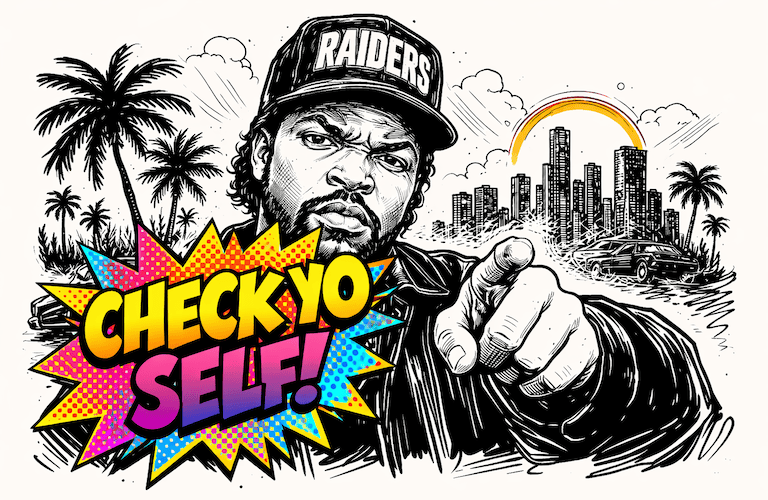
But when Ice Cube dropped “Check Yo Self” in 1993, the whole coastal thing got real quiet for a minute—because the message was bigger than geography. Yeah, the beat had that L.A. sunshine on it, but the warning hit like a cold slap of truth. It didn’t matter where you were from. If you had a temper, an ego, or something to prove, the song was talking to you.
Back then I was just a teenager trying to survive the social minefield of high school—where one comment could turn into a week-long situation and everybody was performing for somebody. I wasn’t reading Marcus Aurelius. I didn’t know anything about Meditations or Stoicism or “the gap between stimulus and response.” And I’m pretty sure Cube wasn’t in the studio with Seneca on his lap either.
But looking back now? That song was one of my first lessons in self-mastery.
Not the soft, inspirational kind. The real kind.
Street wisdom, Stoic truth
People hear “Stoicism” and think it means being cold. Emotionless. Walking around like a stone statue.
No. Stoicism is about restraint. It’s about discipline. It’s about knowing what’s yours to control—and what isn’t.
And the Stoics were blunt about it: you can’t control other people, outside events, or what life throws at you. You can control your mind. Your choices. Your reaction.
That’s literally what “Check Yo Self” is: a warning about ego. About impulse. About pride making decisions for you.
Because let’s be honest—posturing feels powerful for five seconds. And then it costs you for five years.
The price of the instant reaction
That’s the part that sticks with me as I get older. The song wasn’t just “watch out.” It was: don’t be stupid with your future.
When you’re young, everything feels like a crisis. Every slight feels personal. Every moment feels like you’re being watched and judged. And the instinct is to react—clap back, get loud, prove you’re not soft, prove you’re not scared, prove you’re not the one to play with.
But Cube was basically saying:
That’s exactly how people ruin their own lives.
In his world, the consequences were obvious—violence, jail, worse.
But even in regular life? The traps are just dressed up nicer:
-
The reputation trap: one blow-up and now you’re “difficult” forever.
-
The relationship trap: you say something in anger and it lives in the room permanently.
-
The career trap: you burn a bridge over a tiny ego bruise and suddenly doors don’t open the same way.
Some mistakes don’t come with a reset button. And there’s a specific kind of regret that comes from realizing: I could’ve avoided all of this if I just paused for ten seconds.
Restraint is a power move
What people miss is that the song isn’t glorifying chaos—it’s warning you about it.
Real strength isn’t loud. It isn’t performative. It’s not about “winning” a moment.
It’s the quiet discipline of not taking bait.
Of not handing your steering wheel to someone else’s disrespect.
Because that’s what happens when you react without thinking: you give control away. You let someone else press your buttons and drive your day.
And “checking yourself” is the moment you stop and go:
Is my pride about to cost me my peace?
Why this hits even harder now
If anything, this message is more relevant today than it was in the ’90s—because now we live in a world built to keep you reactive.
Social media wants you angry.
Workplaces reward personalities who provoke.
People poke at you just to see if you’ll flinch.
Everyone’s got an opinion, a take, a screenshot, a timeline.
So the ability to pause—to regulate yourself—to move with intention instead of impulse? That’s rare now. And it’s priceless.
In the workplace
Somebody takes credit. Somebody throws shade. Somebody tries to test you in a meeting.
The impulse is to get sharp.
The check is remembering: your composure is part of your leverage.
Sometimes the strongest thing you can do is say less, stay calm, and let their behavior speak for itself.
In parenting
Kids will test every nerve you have. That’s the job description.
“Checking yourself” in that moment isn’t weakness—it’s leadership. Your reaction sets the temperature of the whole house.
In relationships
This one hurts because it’s true: we often hurt the people we love most because we feel safe enough to let our impulses run wild.
But “check yourself” is love in action. It’s choosing the relationship over the momentary satisfaction of being “right.”
Wisdom over ego
The older I get, the more I realize wisdom is really just this:
being able to see the wreck before it happens.
That song is basically a street-level version of the same ancient truth:
There’s a gap between what happens to you and how you respond.
And in that gap is your freedom.
You don’t control the cut-off in traffic.
You don’t control the disrespectful comment.
You don’t control the coworker trying you.
But you do control whether you wreck your own peace over it.
And sometimes the wreckage isn’t dramatic. It’s not a fight or a headline.
Sometimes it’s just a life full of stress you didn’t need… bridges you didn’t have to burn… and that nagging feeling of I wish I didn’t say that.
I still listen to “Check Yo Self” sometimes. The beat still knocks. It still takes me right back.
But now I don’t just hear a rap song.
I hear a reminder.
Life is going to throw plenty at you that you can’t control.
The only way to survive it with your soul intact is to make sure you’re the one driving.
Before you let your ego grab the wheel and send you off a cliff—pause.
Look at the map.
Check yo self.