Christmas in New York: Why the Most Meaningful Moments Aren’t the Shows
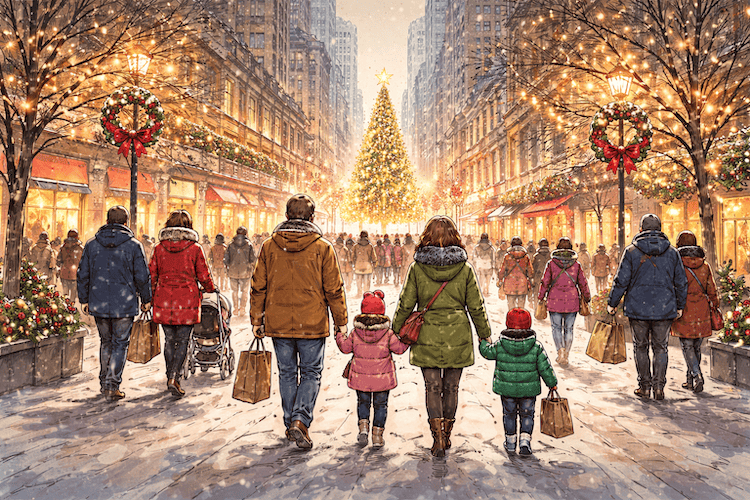
This past weekend, my family and I were fortunate enough to head into the city. We saw the Rockettes, took pictures by the tree, had dinner with friends, and then took the train back home—one of those simple routines that feels especially meaningful during the holidays.
I usually prefer taking the train back rather than driving. We’ll hop on the subway and then catch either Penn Station or Grand Central. This time we chose Penn, and I realized I hadn’t been there in about a year. I was pleasantly surprised by how much it had changed—and I couldn’t help but smile when I spotted the new Van Leeuwen ice cream shop. Family, the city, ice cream—it all felt quietly festive.
But the night had more layers than I expected.
When we walked out of Radio City, we noticed a line of pedicabs, I’m not even sure what they’re officially called. A group of men stood nearby, some dressed as Santa, others just waving people down, offering rides to the train. It was freezing, and this wasn’t something we’d ever done before. My daughter begged my husband, so we said yes.
For about two minutes, one of the men—who appeared to be Middle Eastern—pedaled us down the street and dropped us off at the nearest train station. It was a short ride. The price was $20. But when my husband got off, he handed him $40 and wished him happy holidays.
And that’s when it hit me.
This man had just pulled nearly 350 to 400 pounds through cold city streets—my husband alone is over 200 pounds, and my daughter and I together are under 200 lbs. It wasn’t easy labor. It was physical. It was tiring. And he was doing it for a chance to make forty dollars.
In this day and age, some people are still working that hard—purely with their bodies—just to get by. He seemed like an immigrant, doing what he could, taking what work was available, making the best of things without complaint. There was something deeply humbling about that exchange.
And then, as we continued walking through Penn Station, the contrast became unavoidable.
Along the sidelines were people trying to keep warm, sitting quietly with whatever belongings they had, watching families pass by with shopping bags, warm coats, places to go. For them, a safe place to sleep—or simply staying warm through the night—isn’t guaranteed. It’s a blessing.
That’s what made the moment linger.
On one end of the spectrum, a man working relentlessly, using his strength to earn something. On the other, people with nothing left to give but their presence, hoping to survive the cold. And in between, families like mine—moving through the city, largely unaware of how fragile the line really is.
Especially during the holidays, when there’s so much emphasis on abundance, celebration, and excess, these moments land differently. They force you to pause. To notice. To feel grateful—not in a performative way, but in a quiet, sobering one.
Grateful for warmth.
For shelter.
For the ability to go home.
That night, I didn’t walk away feeling festive. I walked away feeling humbled. And honestly, that felt just as important.