
Pop Culture Therapy: How Movies and Shows Can Heal Your Inner Child
We’ve all been there.
It’s around 8:00 PM after another oddly draining day at work. You’re worn out from the quiet performance of “holding it together” — the commute, the emails, the meetings, and the emotional energy it takes just to get through the day without unraveling.
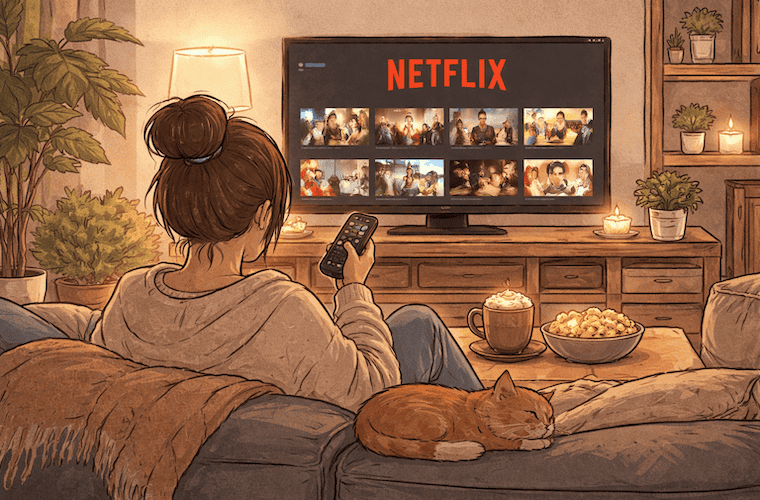
You finally sink into the couch and start scrolling through Netflix or Disney+, looking for something — anything — that will help you shut your brain off before tomorrow starts all over again.
And then something shifts.
Maybe it’s a green witch flying across the screen. Maybe it’s a cartoon dog wobbling on a bike. Maybe it’s a sitcom you’ve already watched more times than you’ll admit.
Suddenly, you’re not just zoning out. You feel lighter. Younger. For thirty minutes, the weight of being an adult loosens its grip.
For a long time, I thought this meant I was overly sensitive or somehow stuck in the past. But the truth is simpler: whether it’s animation or a comfort rerun, these stories help us understand ourselves. We don’t just watch for entertainment — we watch because something inside us feels seen.
That’s what I mean by Pop Culture Therapy: the idea that the stories we’re drawn to aren’t random. They’re quiet clues pointing to what our inner child still needs.
The “Comfort Character” Effect: Why We Rewatch
Why do we choose The Office, Parks and Recreation, or Seinfeld for the tenth time when there are a million new shows out there?
Psychologists talk about something called the “mere-exposure effect.” It’s a real thing: the more we experience something, the more we tend to like it, simply because it’s familiar. In plain language, this means that when the world feels chaotic or unpredictable, our brains love slipping into a story we already know. There are no surprises. No emotional guesswork. Just characters, jokes, and rhythms that feel like coming home.
And there’s more to it than comfort. We don’t just pick familiar stories because they’re easy — we pick the ones that help us feel something we’ve been missing:
-
We watch villains to make sense of anger we don’t express.
-
We watch love stories to soften loneliness.
-
We watch cartoons to reconnect with a sense of childhood wonder.
Paying attention to why a certain scene makes you feel something can sometimes unlock insights that journaling doesn’t — because stories connect with our emotions in ways plain words sometimes can’t.
1. Re-Parenting Ourselves (The Bluey Lesson)
If you’re an adult watching Bluey — with kids, without kids, or paying more attention than your kids are — you’re not alone.
A lot of adults aren’t watching for the games or jokes. We’re watching for the parents we wish we had… or the parents we’re trying really hard to be.
In Sleepytime, a puppy’s dream quietly explores independence and reassurance. I’ve written about how[Sleepytime is actually an episode for the adults], reminding us that even when we’re on our own, we’re still held in love.
And in The Bike, Bluey pushes back against perfectionism. It is a profound look at [the power of persistence]and the idea that falling down isn’t failure — it’s part of learning.
2. Embracing the Parts of Ourselves We Were Told to Hide
Sometimes the cheerful hero doesn’t do it for us. Sometimes, we need the outcast.
Women are often taught to be pleasant, agreeable, and easy to deal with. So when we see characters who are messy, angry, misunderstood, or labeled “too much,” something clicks.
In Guillermo del Toro’s Frankenstein, the creature isn’t a villain — he’s abandoned. In my review of [Del Toro’s beautifully broken monster], I explore how he becomes a mirror for anyone who has ever felt unwanted or on the outside looking in.
And in Wicked, the so-called villain is simply a woman who didn’t fit neatly into society’s expectations. There is a reason[Wicked is the movie that stayed with me]; it reminds us that the people who challenge us often change us the most.
3. Family Dynamics: Seeing Our Drama on Screen
Nothing hits quite like family stories. Sometimes it takes watching fictional families to realize that what we grew up calling “normal” wasn’t always healthy.
Shows like Yellowstone or Your Friends and Neighbors give us just enough distance to look at loyalty, rivalry, and unspoken roles without feeling overwhelmed. I recently broke down[what these TV siblings say about our own family dynamics], noting how we start to notice patterns — not just on screen, but in our own lives.
How to Practice Pop Culture Therapy
You don’t need a degree for this. Just curiosity. The next time a show or movie makes you emotional, pause and ask yourself:
-
The Mirror: Which character is bothering me the most — and why?
-
The Comfort: Why do I keep coming back to this story? What feeling am I craving right now?
-
The Lesson: If this character can survive their chaos, what does that say about my own resilience?
It’s Not Just “Screen Time”
It’s time to stop feeling guilty about the stories that comfort us.
If you’re watching Bluey to soothe your inner child, or Frankenstein to make sense of loneliness, that isn’t wasted time. That’s emotional work.
So the next time you hit play, don’t rush past the feeling. Pay attention to it. You might realize the lesson you’ve been searching for was quietly waiting in your queue all along.