


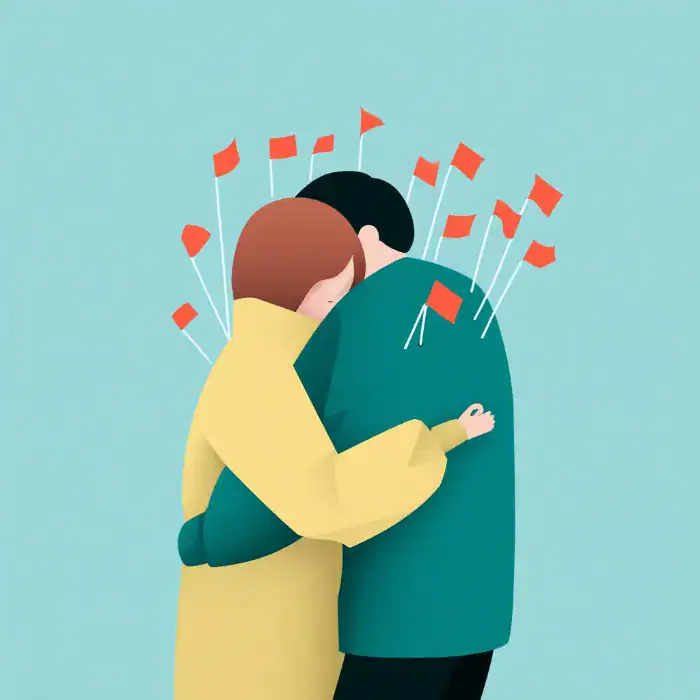
Red Flags in Relationships: How I Learned to Trust My Instincts
I grew up believing anger was something to fear.
In my childhood home, anger wasn’t a disagreement or a raised voice during an argument. It was unpredictable, frightening, and sometimes violent.
I never knew when my father’s temper would turn against my mother.
So I learned to pay attention.
The change in his demeanor. The shift in his voice. The tension that seemed to fill a room before anything actually happened.
I became remarkably good at recognizing when something wasn’t right.
And when I sensed danger, I learned to get away.
I didn’t understand it at the time, but those early experiences would shape the relationships I entered as a young woman.
Years later, I would find myself drawn to men who carried some of the same characteristics I’d spent my childhood trying to escape.
And for a long time, I couldn’t understand why.
Why Familiarity Can Feel Like Attraction
When I was younger, I sometimes found myself attracted to men who were emotionally unpredictable.
There was something about them I recognized.
A certain intensity.
An edge.
A way of making me feel as though I needed to pay close attention to their moods.
Looking back, I can see that what felt familiar wasn’t necessarily healthy.
I had grown up in an environment where reading someone’s emotions was a form of self-protection.
And without realizing it, I carried that habit into adulthood.
I’d meet someone, feel an attraction, and begin a relationship.
But there was often something beneath the surface that made me uneasy.
Sometimes it was the way he spoke about former partners.
Sometimes it was the inconsistency between what he said and what he did.
Other times, it was the way affection could suddenly turn into coldness.
And I would wait.
Not necessarily because I believed everything was fine, but because I wanted to understand what I was seeing.
Eventually, the patterns became difficult to ignore.
And when they did, I left.
I was never physically abused by these men.
But I experienced psychological manipulation, emotional inconsistency, and relationships that left me questioning my own judgment.
The strange thing was that I often sensed something was wrong long before I was willing to acknowledge it.
I recognized the warning signs. I just hadn’t learned to trust myself enough to act on them sooner.
The Red Flags in Relationships I Learned to Recognize
Not every disagreement is a red flag.
Not every difficult personality is abusive.
And not every uncomfortable feeling means someone has bad intentions.
I’ve learned that distinction with age and experience.
But I’ve also learned that certain patterns deserve attention, especially when they happen repeatedly.
1. Their Words and Actions Don’t Match
Someone can tell you everything you want to hear.
They can make promises, talk about the future, and describe the kind of relationship they want.
But words mean very little without consistent behavior.
I learned to pay attention to what someone actually did rather than what they repeatedly promised to do.
A single broken promise doesn’t necessarily define a person.
But a continuing pattern of dishonesty, excuses, and inconsistency can reveal something important.
2. Affection Is Followed by Unexplained Coldness
One of the most confusing experiences in a relationship is feeling close to someone one day and emotionally shut out the next.
At first, you may assume you’ve done something wrong.
You replay conversations.
You wonder whether you said something offensive.
You try harder to restore the connection.
Of course, everyone has difficult days and moments when they need space.
But when affection and withdrawal become a repeated pattern that leaves you anxious and uncertain, it’s worth examining.
A healthy relationship shouldn’t require you to constantly guess where you stand.
3. You Begin Questioning Your Own Reality
There were relationships in which I found myself questioning things I had clearly observed.
Conversations would be denied.
Events would be remembered differently.
My concerns would be dismissed as overreactions.
And eventually, I’d begin wondering whether I was simply too sensitive.
This kind of repeated manipulation can undermine your confidence in your own judgment.
Disagreements about memories happen in ordinary relationships, too. But persistent denial, distortion, or deliberate attempts to make someone doubt their perception can be signs of emotional abuse.
When a relationship repeatedly leaves you doubting your own reality, pay attention to the pattern.
4. You Feel Responsible for Managing Their Emotions
This one was particularly familiar to me.
Growing up, I learned to observe my father’s moods because I wanted to avoid conflict and danger.
As an adult, I sometimes found myself doing something similar.
Choosing my words carefully.
Anticipating reactions.
Trying to keep the peace.
Avoiding conversations because I didn’t know how someone would respond.
There is a difference between being considerate of your partner’s feelings and feeling responsible for preventing their anger.
You can communicate respectfully.
You can be thoughtful.
But you cannot control another adult’s emotional reactions.
And you shouldn’t have to live in constant anticipation of them.
5. Your Boundaries Are Repeatedly Disregarded
A boundary doesn’t have to be dramatic.
Sometimes it’s as simple as saying you need time alone.
Or that you don’t want to discuss something.
Or that a particular behavior makes you uncomfortable.
In a healthy relationship, people may not always agree with your boundaries, but they should be willing to discuss and respect reasonable limits.
When someone repeatedly pressures you, dismisses your concerns, or punishes you for saying no, that’s worth taking seriously.
I’ve come to believe that how someone responds to a boundary can tell you a great deal about the relationship.
What My Anger Was Actually Telling Me
For years, I thought my anger was the problem.
When I became upset in a relationship, I sometimes questioned whether I was being unreasonable.
Maybe I expected too much.
Maybe I was too sensitive.
Maybe I needed to be more patient.
But eventually, I began looking at my anger differently.
My anger wasn’t necessarily the problem. Sometimes it was pointing toward the problem.
It was telling me that something mattered.
That I felt disrespected.
That I was uncomfortable.
That my expectations and the reality of the relationship weren’t lining up.
But I’ve also learned something important.
Anger is information, not a verdict.
It can alert you to a problem, but it doesn’t automatically tell you what caused that problem or what another person intended.
Sometimes our reactions are influenced by past experiences.
Sometimes we misunderstand situations.
And sometimes our discomfort is responding to a genuine pattern of manipulation or mistreatment.
The challenge is learning to distinguish between those possibilities.
For me, that meant paying attention to both my feelings and the facts.
Not dismissing my anger.
But not allowing it to make every decision for me, either.
The Difference Between Healthy Anger and Destructive Rage
This distinction took me years to understand.
As a child, I associated anger with losing control.
I witnessed what happened when anger became intimidation and violence.
So naturally, I wanted to distance myself from it.
But anger and aggression aren’t the same thing.
Anger is an emotion.
Aggression is a behavior.
You can feel angry without threatening someone.
You can be deeply upset without screaming.
You can recognize that you’ve been mistreated without seeking revenge.
Healthy expressions of anger can involve communicating a boundary, addressing a problem, or deciding that a relationship is no longer right for you.
Destructive expressions of anger may involve intimidation, threats, humiliation, or violence.
And I’ve learned that the quietest response can sometimes be the strongest.
You don’t always need an argument.
You don’t always need to convince someone that you’re right.
Sometimes you simply need to recognize what you’re experiencing and decide what you’re willing to accept.
I explore this idea further in How to Use Anger as Fuel, where I explain how difficult emotions can become a starting point for constructive change.
Learning to Trust My Instincts Without Letting Fear Lead
One of the more complicated lessons I’ve learned is that growing up in an unpredictable environment can make you extremely observant.
You notice small changes.
A shift in someone’s voice.
A change in expression.
A sudden difference in behavior.
Sometimes those observations are useful.
But sometimes your nervous system may react to something that reminds you of the past, even when the present situation is different.
That’s why I’ve learned not to treat every uncomfortable feeling as proof that something is wrong.
Instead, I ask myself questions.
What exactly am I noticing?
Is this an isolated incident or a repeated pattern?
Am I responding to something happening now, or something that reminds me of an earlier experience?
Do this person’s actions consistently match their words?
Can I express discomfort without fearing retaliation?
Do I feel respected and emotionally safe in this relationship?
These questions help me distinguish between instinct, fear, and observable behavior.
And sometimes the answer becomes clearer with time.
Trusting yourself doesn’t mean assuming you’re always right. It means taking your own observations seriously enough to examine them.
Why I Stopped Waiting for People to Show Their True Colors
When I was younger, I often stayed in relationships longer than I should have.
Not because I was unaware of the warning signs.
Sometimes I was very aware.
But I wanted confirmation.
I wanted to know whether my concerns were justified.
I wanted the other person to reveal something unmistakable so I could leave without second-guessing myself.
Looking back, I realize I was placing an enormous burden on myself.
I didn’t need to prove someone was a terrible person to decide that a relationship wasn’t right for me.
I didn’t need a dramatic confrontation.
I didn’t need to wait until the situation became unbearable.
And I didn’t need permission to leave.
That realization changed the way I approached relationships.
I began paying closer attention to consistency, emotional availability, honesty, and mutual respect.
I stopped focusing exclusively on whether someone wanted me.
I started asking whether I actually wanted the relationship they were offering.
There’s an enormous difference.
And I wish I’d understood it sooner.
You Can Recognize a Red Flag Without Trying to Fix the Person
This is another lesson that took time.
When you recognize unhealthy behavior, it’s tempting to believe you can explain it away.
Maybe the person had a difficult childhood.
Maybe they’re under stress.
Maybe they’ve never experienced a healthy relationship.
Maybe they simply need someone patient enough to understand them.
Those things may provide context.
But they don’t automatically excuse harmful behavior.
And understanding why someone acts a certain way doesn’t make you responsible for changing them.
You can have compassion for another person’s struggles while recognizing that their behavior isn’t something you want in your life.
You can care about someone and still decide the relationship isn’t healthy.
You can wish someone well without continuing to participate in the same painful pattern.
I’ve learned that emotional strength sometimes means accepting people as they are rather than becoming consumed by who you hope they’ll become.
That doesn’t mean people can’t change.
It means change has to come from them.
You cannot do that work for someone else.
What Changed When I Started Trusting Myself
I didn’t suddenly become fearless.
I didn’t stop feeling attracted to complicated people overnight.
And I certainly didn’t become someone who always made perfect decisions.
What changed was my willingness to take my own discomfort seriously.
I stopped dismissing every concern as an overreaction.
I stopped assuming that patience could resolve every problem.
And I stopped believing that leaving a relationship meant I had failed.
Sometimes leaving was simply an acknowledgment that something wasn’t right for me.
I also became more comfortable with uncertainty.
I didn’t always need to understand why someone behaved a certain way.
I didn’t need to diagnose their personality.
I didn’t need to prove that my interpretation was correct.
I needed to decide whether the relationship was healthy, respectful, and compatible with the life I wanted.
That was enough.
And with time, I began to recognize something else.
The more I trusted my ability to make decisions, the less I needed constant reassurance from other people.
I could listen to advice without surrendering my judgment.
I could consider another perspective without automatically dismissing my own.
And I could walk away from something that wasn’t right without spending months trying to justify my decision.
That, to me, is part of what it means to be an emotionally strong woman.
Not someone who never doubts herself.
Someone who learns to make thoughtful decisions even when doubt is present.
For the Women Who Recognize Themselves Here
Maybe you grew up in a home where anger felt frightening.
Maybe you learned to keep the peace before you learned to express your own needs.
Maybe you’ve found yourself attracted to people who remind you of relationships you promised yourself you’d never repeat.
Or maybe you’ve spent years questioning whether your feelings were justified.
I understand some of those experiences because I’ve lived them.
And if there’s something I wish I could tell my younger self, it’s this:
You don’t have to ignore your discomfort to prove you’re understanding.
You don’t have to remain in a relationship simply because you see someone’s potential.
You don’t have to wait for a situation to become unbearable before deciding it’s not right for you.
And you don’t have to confuse emotional strength with endless tolerance.
Sometimes strength means having a difficult conversation.
Sometimes it means establishing a boundary.
Sometimes it means seeking support.
And sometimes it means leaving.
If you’re experiencing intimidation, coercion, or abuse, your safety matters more than resolving an argument or getting someone to acknowledge your perspective. Seeking confidential support and making a safe plan can be more important than confronting the person directly.
Final Thoughts: Your Instincts Deserve Your Attention
For much of my childhood, anger represented something frightening.
It was unpredictable.
It was destructive.
It was something I wanted to escape.
But growing older taught me that anger doesn’t always have to be an enemy.
Sometimes it can draw our attention to something we’ve been trying not to see.
A boundary that’s been crossed.
A pattern that keeps repeating.
A relationship that no longer feels healthy.
Or a truth about ourselves that we’re finally ready to acknowledge.
I no longer believe every uncomfortable feeling is automatically correct.
But I don’t dismiss those feelings, either.
I listen.
I observe.
I look for patterns.
And then I decide what to do.
Because learning to trust yourself isn’t about never making a mistake.
It’s about knowing you can recognize a problem, make a decision, and take care of yourself.
My anger once taught me to run from danger. Experience taught me something even more valuable: I could choose where I wanted to stay.
And sometimes, that’s the quietest kind of strength there is.
Frequently Asked Questions About Red Flags in Relationships
What are the biggest red flags in a relationship?
Common warning signs include repeated dishonesty, controlling behavior, intimidation, manipulation, disrespect for boundaries, and patterns that leave one partner feeling unsafe or constantly uncertain. Individual incidents should be considered in context, but repeated harmful behavior deserves attention.
Can anger be a warning sign in a relationship?
Anger can alert you to discomfort, unmet needs, or possible boundary violations. However, anger alone doesn’t establish that someone else has behaved badly. It’s important to examine the situation, identify patterns, and consider the facts before deciding how to respond.
Why do I keep attracting emotionally unavailable people?
There isn’t one explanation. Familiar relationship patterns, attachment experiences, personal preferences, and circumstances can all influence whom we choose. Recognizing recurring patterns can help you make more intentional decisions about future relationships.
How do I learn to trust my instincts in relationships?
Start by paying attention to observable behavior rather than relying exclusively on emotional reactions. Notice whether someone’s actions are consistent, whether your boundaries are respected, and whether you feel safe expressing your needs. Reflection and support from trusted people can help you evaluate patterns more clearly.
Can a relationship recover after red flags appear?
Some relationship difficulties can improve through accountability, communication, and sustained behavioral change. However, patterns involving abuse, coercion, intimidation, or violence require particular caution. Safety should take priority over attempts to repair the relationship.
Is walking away from a relationship a sign of emotional strength?
It can be. Choosing to leave a relationship that is unsafe, harmful, or fundamentally incompatible with your needs may reflect self-awareness and healthy boundaries. Emotional strength also includes recognizing when to seek support and making decisions thoughtfully rather than impulsively.
Read Next
- How to Use Anger as Motivation: Turn Anger Into Fuel
- Signs of a Strong Woman in a Relationship
- Traits of an Emotionally Strong Woman
- How to Let Go of the Past
This article reflects personal experiences and observations. It is not intended to replace professional mental health or relationship support. If you are experiencing relationship abuse in the United States, the National Domestic Violence Hotline offers confidential support at thehotline.org or 800-799-SAFE (7233).