
Wicked: The Kind of Female Friendship We Don’t See Enough
Wicked: For Good is a beautiful movie — not just visually, but emotionally. Behind the fantasy and glitter, it hides a message that cuts right into something a lot of women don’t like to admit out loud: we struggle with each other.
I’ve seen it my whole life — school, college, work, even friendships that were supposed to feel safe. Women sizing each other up, competing silently, comparing, criticizing… sometimes without even realizing it. It starts early, almost before we even find our voice.
And here’s the truth I’ve had to accept about myself:
I’ve felt competition with other women too.
Not because I wanted to, but because it’s ingrained in us before we even understand what we’re competing for. Approval. Belonging. Visibility. Feeling like enough.
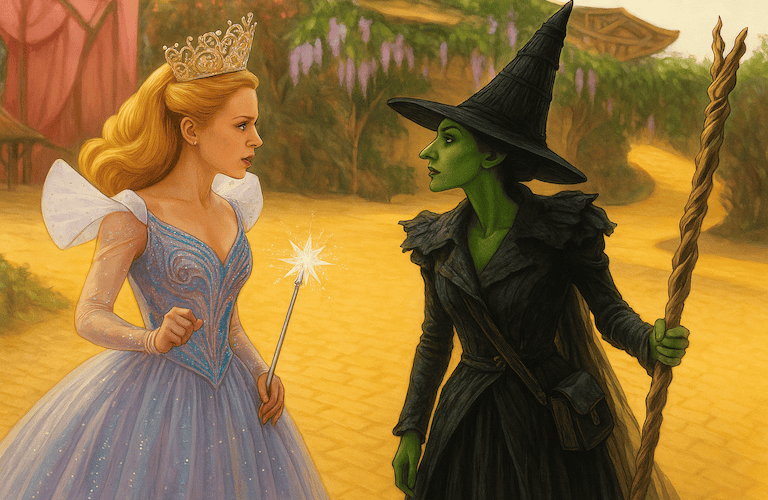
That’s why Wicked hit me different. Because Glinda and Elphaba could’ve easily fallen into that familiar dynamic — two women competing for attention, validation, power, acceptance. And at first, they did. They envied each other for completely opposite reasons:
* Elphaba wanted the acceptance and warmth that Glinda received so effortlessly. She wanted to be seen without having to fight for it.
* Glinda wanted the depth, the purpose, the inner fire that Elphaba carried naturally — the kind of strength you can’t teach or fake.
They each wanted something the other woman had.
Isn’t that the root of most competition?
But what made their story beautiful — and honestly healing — is that they didn’t stay stuck there.
Somewhere along the way, they stopped looking at each other through the lens of “she has what I don’t,” and started seeing each other clearly:
✨ Glinda saw Elphaba’s courage, her moral backbone, her willingness to stand alone rather than betray herself.
✨ Elphaba saw Glinda’s empathy, her ability to inspire people, and her desire to do the right thing even when she was scared.
They both realized something most women don’t get taught:
You don’t have to become the other woman to appreciate her.
And her shine doesn’t dim yours.
That’s the part that stays with me. Because in real life, we’re not conditioned to celebrate each other’s strengths. We’re taught to protect our territory, our image, our place in the room. And the envy we don’t talk about becomes the wall between us.
But Glinda and Elphaba do something different. They accept each other — as is.
Flaws, insecurities, strengths, differences, all of it.
They stop competing and start valuing.
And maybe that’s the lesson Wicked quietly hands women:
we can admire what another woman has without losing ourselves.
We can be different without being at war.
In the end, Glinda couldn’t be Elphaba, and Elphaba couldn’t be Glinda.
But their friendship only worked once they embraced that truth.
Imagine how different our relationships would be if we did the same.