
Is a 14-Hour Fast Enough for Weight Loss? What Happened When I Closed My Kitchen at 5 PM
Most people think intermittent fasting has to be extreme to work.
16 hours. 18 hours. Skipping dinner. Pushing through hunger like it’s a test of willpower.
But what if something much simpler—something almost unnoticeable—was enough to shift how your body feels?
Over the past year, I’ve been following a quiet routine without forcing it. I stop eating at 5 PM and don’t eat again until about 7 AM.
That’s a 14-hour fast.
No apps. No pressure. No obsession.
And what I started noticing wasn’t just about weight—it was clarity, steadiness, and a surprising sense of control around food.
So the real question is:
Is a 14-hour fast enough for weight loss—or is something else happening beneath the surface?
Why Fasting Alone Isn’t Enough
One thing I’ve learned is that fasting works best when it’s paired with what you’re eating.
You can’t rely on a fasting window to offset a day filled with ultra-processed foods, sugar spikes, and constant grazing. The body doesn’t reset that easily.
Fasting gives your body a break—but food quality determines what your body actually does during that break.
One of the biggest shifts for me came when I started paying attention to ingredients and how different foods made me feel.
⭐ If you’re not sure what counts, I break it down here:
[What Are Highly Processed Foods]
⭐ And this is what changed everything for me:
[What Happened When I Started Reading Ingredient Labels]
Once you connect fasting with food quality, the results feel completely different.
What Happens During a 14-Hour Fast
Without getting overly technical, here’s what’s likely happening during that overnight window:
- Your insulin levels begin to stabilize
- Your body gets a break from constant digestion
- Hunger hormones start to regulate
- Your mornings feel clearer and less reactive
It’s not dramatic. It’s subtle.
But over time, those subtle shifts add up.
What My Weekday Routine Actually Looks Like
People always ask what I eat, so here’s what a typical weekday looks like for me.
Around 7 AM, I start simple:
- A small cup of tea with a drop of 1% milk
- Two hard-boiled eggs (sometimes with a little butter)
- My vitamins
I let that carry me for a few hours.
By the time I get to work, I’ll have another tea and a handful of walnuts.
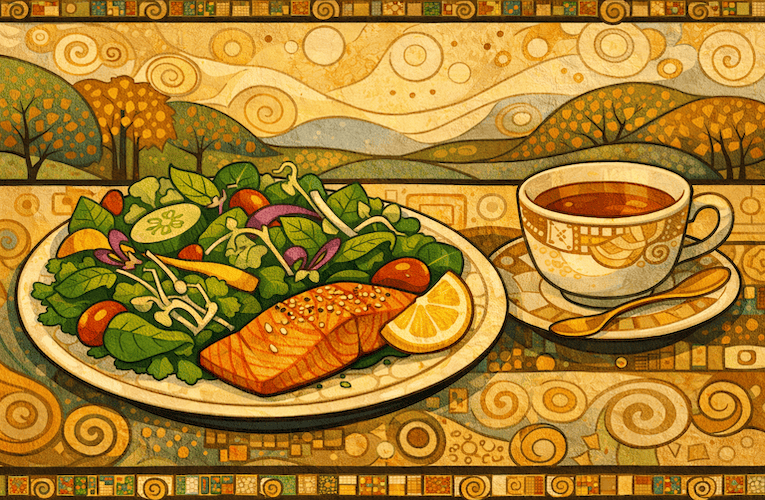
Lunch is usually a large salad—loaded with greens, vegetables, and a solid portion of protein. Nothing complicated, just consistent.
Later in the day, I might have something small like a macaron, more water, and around 4 PM, a light snack like ricotta or cottage cheese.
By 5 PM, the kitchen is closed.
That’s it.
The Discipline Behind It (Without the Pressure)
At one point, I realized something:
This isn’t about restriction—it’s about boundaries.
I think about the Bluey episode “Bike” when I’m tempted to wander back into the kitchen at 8 PM. There’s no big speech. Just the quiet decision to try again.
That’s what this is.
Not perfection. Not punishment. Just choosing not to reopen the kitchen.
And that small decision, repeated daily, builds more discipline than any extreme plan ever could.
How I Handle Weekends
Weekends are more relaxed—but not chaotic.
If I want a burger, I’ll have one. But I won’t go all in with fries and soda and dessert like I used to.
Maybe a few fries. A bite or two of something sweet. Enough to enjoy it without feeling heavy afterward.
I’ve learned that it’s not about cutting things out—it’s about not letting one meal turn into an entire spiral.
Why This Approach Works
What surprised me most about this routine is how calm it feels.
There’s no constant thinking about food. No late-night snacking. No feeling like I need to “start over” the next day.
Just a simple rhythm:
Eat earlier in the day.
Stop at 5 PM.
Start again at 7 AM.
That overnight break gives your body space.
And when your body has space, everything feels a little more in control.
Want to Go a Step Further?
⭐ If you’re curious about extending your fasting window, you might enjoy:
[What Fasting 16 Hours a Day Has Taught Me]
My Takeaway
So—is a 14-hour fast enough for weight loss?
Yes. But not because it’s extreme.
Because it’s consistent.
Closing the kitchen at 5 PM isn’t dramatic. It’s quiet. Repetitive. Almost invisible.
But over time, those small boundaries reshape how you eat, how you feel, and how much control you have over your day.
It’s not about doing more.
It’s about removing just enough noise for your body to finally settle.
Ready to Find Your Own Rhythm?
Closing the kitchen is a physical habit—but staying consistent is a mindset.
If you’re working on building quiet confidence in your health, your habits, or even your career, you might enjoy:
[10 Quiet Japanese Principles That Can Shift Your Life]
Join the Conversation
Do you think a 14-hour fasting window could work for your schedule?
Or are late-night cravings your biggest challenge?
I’d love to hear how you’re navigating it.
And if you want more insight like this—simple habits, real routines, and clarity without the noise—
⭐ [Sign up for my newsletter]