


Why I Stop Eating at 5 PM: What a 16-Hour Fast Taught Me About Mental Clarity
I didn’t start fasting because I read an article about metabolic efficiency or watched a wellness influencer talk about autophagy. I started because something felt fundamentally wrong, and I couldn’t figure out what it was.
For years I woke up feeling fog in my head that took hours to lift. Not tired exactly — fog. The kind where your thoughts move slowly, your body feels heavy, and you can’t quite shake the sensation that you’re moving through the day instead of in it.
I blamed stress. Then hormones. Then age. But the pattern was always the same: I’d start each morning behind, spend the day catching up, and by evening I’d be reaching for comfort foods without even thinking about it. Sugar, carbs, packaged things. Whatever was easiest. My mood would shift with the crashes. I’d feel irritable, reactive, not quite like myself.
And then I’d wake up foggy again.
That cycle went on for longer than I want to admit. It felt like just how my body worked, how my emotions naturally were. Until I realized it wasn’t natural at all — it was a symptom of never giving my body a break from digestion.
The Thing Nobody Talks About When You Talk About Fasting
When people discuss intermittent fasting, they talk about weight. Metabolism. Insulin. Calorie windows.
What they don’t talk about — or at least, what I didn’t hear — is how much clearer your mind gets when you stop treating your body like it’s always supposed to be digesting something.

When I decided to stop eating at 5pm, I wasn’t thinking about fasting. I was thinking about how to feel clear again.
I was eating constantly. Breakfast at 7, snacks at 10, lunch at 12, afternoon grazing, dinner, late-night TV snacking. My body was never actually resting. And I think now that’s where the fog came from. Not from what I was eating — though that mattered — but from the fact that I was never giving my body time to reset.
The acid reflux that woke me at 2 AM finally made the decision for me. I couldn’t keep eating late into the evening. So I made a simple rule: I stop eating at 5pm.
That one change shifted everything. Not because fasting is magic. But because for the first time in years, my body got a real break. And when your body rests, your mind gets clearer.
What Changed When I Stop Eating at 5pm: The First Few Weeks
I noticed the physical stuff first — less bloating in the morning, no reflux waking me up, mornings that didn’t feel heavy.
But the mental shift came next, and it was bigger.
My head got quieter. And that’s when I realized: when I stop eating at 5pm, I’m not just creating a fasting window. I’m creating space for my mind to actually rest.
I stopped waking up thinking about food. That constant mental negotiation — should I eat, what should I eat, I shouldn’t have eaten that — just… stopped. Because the decision was already made. Kitchen closes at 5 PM. That’s it.
And somewhere around week three, I realized something important: I wasn’t just feeling less foggy. I was feeling more like myself. More capable. More in control. The kind of clarity where you can actually think about what you need, instead of just reacting to cravings and crashes.
That’s when I understood that fasting wasn’t about restriction for me. It was about restoration.
The Routine That Actually Works: Stop Eating at 5pm
I don’t do this perfectly, and that’s the point. Perfection would mean I’d quit by week two.
Monday through Thursday, I stop eating at 5 PM and don’t start again until 7 AM. That naturally creates a 14-16 hour fasting window depending on when I wake up and when I close the kitchen. The rhythm is what matters — not the perfection.
Here’s what a typical day actually looks like:
7:00 AM — Water first. Then tea with a small splash of 1% milk. Two eggs (I scramble them, or soft boil them). Vitamins.
9:00 AM — Another tea. A handful of walnuts or almonds. Sometimes cottage cheese with a drizzle of honey.
12:00 PM — A real lunch. Protein-focused — salmon or chicken, a large salad, plenty of vegetables. Nothing complicated.
2:00–3:00 PM — A small snack if I need it. Berries. An apple. A few pieces of dark chocolate (I mean a few, not half the bar).
4:00 PM — Maybe a small portion of ricotta or Greek yogurt if I’m still a bit hungry.
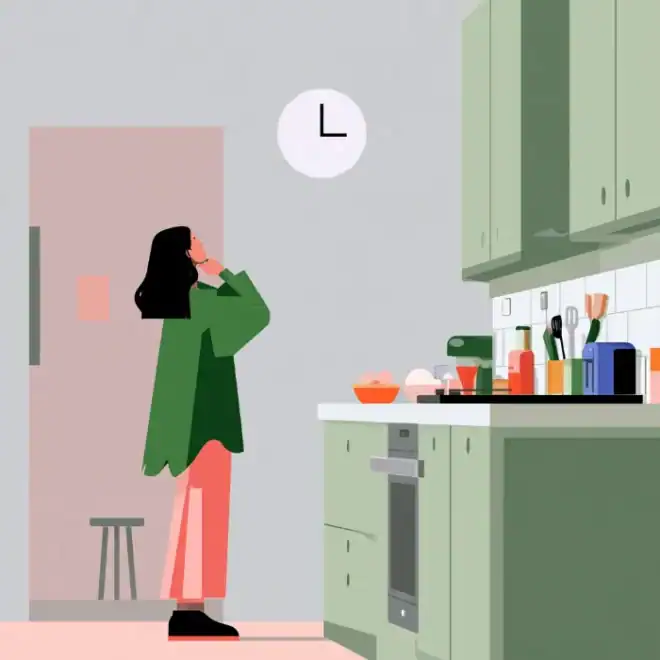
5:00 PM — Kitchen closes. Done.
Friday and Saturday — I eat more loosely. Not out of control, but I let myself enjoy meals without the same structure. Maybe dessert. Maybe a dinner out. No guilt.
Sunday — I reset.
This isn’t strict. Some weeks the routine shifts because life happens. But the anchor holds: most weekdays, eating window closes in the late afternoon.
What Actually Happens in Your Body (Without the Science Jargon)
I’m not a doctor, and I won’t pretend to be. But here’s what I’ve noticed, and what some research suggests might be happening:
When you stop constantly digesting food, your body gets a chance to work on other things. Blood sugar stabilizes. That constant spike-and-crash cycle — where you eat, get a sugar rush, crash, feel foggy, reach for more sugar — that finally breaks.
Without that cycle, your energy becomes steadier. Your cravings quiet down. Your brain doesn’t spend all day managing the next energy crash.
For me, that steadier energy meant I could actually think clearly instead of just reacting. And mental clarity turned out to be worth more than any weight loss.
Where Supplements, Movement, and Mindfulness Fit Naturally
I don’t take a lot of supplements, but the ones I use matter more now that my body has actual space to process them.
I started noticing — because I was paying more attention — what actually supported the fasting window. Electrolytes helped in those early weeks when my body was adjusting. A simple magnesium at night helped with sleep quality. An omega-3 because I was eating more fish. Nothing extreme, just awareness of what my body actually needs rather than what marketing tells me I need.
Not because I needed to optimize everything. Just because when you’re not in constant digestion mode, you start to notice what your body actually needs.
Movement looks different too. I’m not doing intense workouts during my fasting window — that would drain me. But morning walks, gentle stretching, yoga on the mat — those feel better, smoother, like my body has energy for them instead of being sluggish. And the interesting part? When your body feels steadier, you want to move it. Not to punish it or earn your food. Just because it feels good.
And mindfulness became almost accidental. When you’re not snacking mindlessly at your desk, you notice what you’re actually feeling. Stressed? Bored? Lonely? You can’t just eat your way past it anymore. You have to actually feel it. Which sounds harder, but it’s actually easier — because you start understanding yourself better.
→ For more on building practices that support emotional clarity, see: Traits of an Emotionally Strong Woman
The Unexpected Benefit: Emotional Steadiness
This is the part that changed my life more than I expected.
When your blood sugar is stable, your moods are more stable. It’s not poetic — it’s physiology. Research shows that blood sugar fluctuations directly impact mood regulation and emotional stability. Those afternoon crashes that used to hit me around 3 PM? They were real. They were also making me irritable, defensive, and emotionally reactive in ways I couldn’t control. I’d snap at people. I’d interpret neutral comments as personal slights. I’d feel overwhelmed by things that normally wouldn’t get to me.
I thought it was just my personality. Turns out, a lot of it was my blood sugar.
When you’re not in a constant state of craving something, your emotional state becomes clearer too. You can distinguish between “I’m actually hungry” and “I’m stressed and looking for comfort” — and that distinction matters more than you’d think. Because that’s where patterns live. That’s where you can actually choose differently.
I noticed I got less reactive. Less snappy. Less caught in the emotional ups and downs that used to feel inevitable. More importantly, I started noticing the difference between a legitimate emotional response and an emotionally dysregulated one. That gap — that space where you can actually make a choice — that changed everything.
For someone like me — someone who’s been working on emotional strength and understanding how anger and overwhelm move through my body — that steadiness became the foundation. You can’t build emotional resilience on a shaky blood sugar foundation. It doesn’t work. Your nervous system is too busy managing the crash to actually process anything else.
Fasting gave me that stability. And with that stability came clarity about what I actually needed versus what I was just reaching for out of habit. I could finally hear the difference between my real needs and my conditioned impulses.
→ For more on this, read: How to Use Anger as Motivation — understanding your emotional patterns gets so much clearer when your body isn’t running on chaos.
Why I Don’t Force 16 Hours
People ask if 16 hours is better than 14. Here’s my honest answer: not if the extra two hours make you miserable.
I naturally hit 16 hours on most weekdays. But some days it’s 14, and that’s fine. Consistency matters infinitely more than intensity.
If you’re new to this, start with 12 hours. Move to 14. See how you feel. Don’t force it. The goal isn’t to prove something — it’s to find a rhythm you can actually sustain through a hard week, a busy season, and a life that doesn’t always cooperate.
The fasting window that works is the one you’ll come back to.
How to Actually Start (Without Making It Complicated)
Don’t jump into a 16-hour window tomorrow. That’s how you quit by Friday.
Week 1: Stop eating one hour earlier than you currently do. That’s it. Nothing else changes. You’ll probably feel a little hunger signal in the evening — that’s normal. It’s not your body telling you something is wrong. It’s just habit. Have tea. Drink water. Let it pass.
Week 2: Move your cutoff one more hour earlier. By now, you might notice some small shifts — maybe you wake up slightly less bloated. Maybe your 3 PM crash isn’t quite as brutal. Pay attention to these small things.
Week 3: Adjust based on how you’re feeling. If this is sustainable, keep it. If it feels genuinely hard (not just uncomfortable, but actually hard), back it up 30 minutes and stay there for another week.
Week 4 onward: Stay consistent for at least a month before you evaluate anything. One week isn’t enough data. Your body needs time to adapt to this new rhythm.
A note on the hardest moment: The hardest part is the evening — specifically that 7–9 PM window when you’re tired, bored, and the kitchen is calling. This is where habits live. This is where most people break. Have a plan for that time. Not a vague “I’ll distract myself” but an actual plan. Tea at 5:30 PM signals to your brain that eating is done. A walk. A podcast. A shower. Anything that’s not standing at the counter deciding what to eat. Create friction between you and mindless snacking. By week three, that window gets easier. By week four, it feels normal — which is when the real benefits start showing up.
What if you slip? You will. Someone brings birthday cake to work. You have a hard day and want comfort food. You eat dinner at 6 PM instead of 5 PM. That’s fine. One meal doesn’t undo the pattern. Come back to the rhythm the next day. Consistency beats perfection every single time.
→ For the mental side of creating sustainable routines, read: Best Morning Routine for Women Over 40
The Real Shift: Why I Stop Eating at 5pm Now
This isn’t about starving. It’s not about punishment or restriction.
It’s about realizing that constantly feeding your body doesn’t actually feed your clarity, your peace, or your emotional stability. In fact, it does the opposite.
When I chose to stop eating at 5pm and gave my body real space to rest, my mind got quieter. My mornings got lighter. My emotional state became something I could actually work with instead of something constantly thrown off-balance by blood sugar crashes.
That clarity — that mental steadiness — became the biggest gift of all.
And it started with one simple decision, repeated quietly night after night: stop eating at 5pm. Start again in the morning. Build a rhythm. Stick to it.
FAQ: Stop Eating at 5pm — Common Questions
If I stop eating at 5 PM, what about dinner?
When I stop eating at 5 PM, I don’t eat dinner in the traditional sense. For my family, I cook — I just don’t eat it. Some people find this strange. For me, it’s the trade-off that makes everything else possible. The mental clarity I get from honoring that boundary is worth it. If your schedule doesn’t work with 5 PM, move your cutoff to 6 or 7 PM. When you stop eating matters less than the consistency of it.
How long until I notice a difference?
Physically — reduced bloating, lighter mornings — most people notice within 1–2 weeks. Mentally — the fog lifting, cravings quieting — usually takes 3–4 weeks of consistency. Emotional steadiness takes longer. By week 6–8, you’ll have a clearer sense of whether this is actually working for you.
Will I get hungry?
Yes, especially in the evening during week one. But there’s a difference between real hunger and habit hunger. You can be genuinely fine without food and still feel the urge to eat because that’s when you normally eat. Drink water. Have tea. The feeling passes. If you’re genuinely physically hungry on most days by week 3, you might need to eat a larger lunch or your body might need a different fasting window.
What if my schedule doesn’t allow a 5 PM cutoff?
Then pick a time that works. 6 PM, 7 PM, whatever is realistic for your life. The principle is the same — create a consistent cutoff that gives you roughly a 12–14 hour fasting window overnight. A rhythm you can actually stick to beats the “perfect” timing every time.
Will this work for weight loss?
It might. For me, the physical changes were nice but secondary to the mental clarity and emotional steadiness. If your only goal is weight loss, fasting alone won’t do it — what you eat during your eating window matters just as much as when you eat. But if you’re looking for mental clarity, steadier energy, and emotional regulation, that often comes with the territory.
What can I have while fasting?
Water, plain herbal tea, black coffee, and regular tea with a small splash of milk are all fine. I personally drink tea in the evenings because it signals to my brain that eating is done for the day. Avoid anything with calories or sweeteners — even sugar-free drinks can sometimes trigger hunger signals for some people.
Is this safe for everyone?
For most healthy people, a 14-hour overnight fast is gentle and manageable. But it’s not appropriate if you have a history of disordered eating, certain health conditions, or if you’re pregnant or breastfeeding. Always check with your healthcare provider before starting, especially if you’re on medication or have any existing health concerns. Mayo Clinic has a helpful overview of intermittent fasting if you want more clinical context.
What about weekends?
On weekends, I don’t stop eating at 5 PM with the same rigidity. I eat more loosely on Friday and Saturday — dinners out, dessert, less structure. Then I reset on Sunday and return to stopping eating at 5 PM. This flexibility is what makes it sustainable. If you have to be perfect seven days a week, you’ll quit. Permission to have easier days, and then recommitting to the rhythm, is part of what makes this work long-term.
What if I slip and eat after 5 PM?
Nothing happens. You just come back to it the next day. One meal doesn’t undo a pattern. If you’re consistently slipping, it might mean your cutoff time is unrealistic for your life — which is valuable information. Adjust and try again.
Does this replace other healthy habits?
No. Fasting creates structure and mental clarity, but it doesn’t replace whole food eating, movement, sleep, or stress management. It works best as part of a bigger picture. The mental clarity you get from fasting actually makes it easier to choose other healthy habits — because you’re thinking more clearly.
→ For a complete picture of what supports emotional and mental wellness, read: Traits of an Emotionally Strong Woman
Where to Go From Here
If this resonates and you want to go deeper:
→ Traits of an Emotionally Strong Woman — Understanding emotional strength changes how you work with your body and habits.
→ How to Use Anger as Motivation — When your mind gets clearer, you can actually work with your emotions instead of being controlled by them.
→ Best Morning Routine for Women Over 40 — Your morning starts the night before. When your evening routine supports your fasting window, everything else becomes easier.
→ Stronger Than You Think: Your Emotional Wellness Guide — Free resource for building lasting emotional stability.
A Note on This Approach
This post reflects my personal experience and observations. Fasting isn’t the right choice for everyone, and individual bodies respond differently. Always consult your healthcare provider before making significant changes to your eating patterns, especially if you have any existing health conditions, are on medication, or have a history of disordered eating.
The goal here isn’t perfection or extremes. It’s finding what actually supports your body, your mind, and your life — and having the courage to stick with it. That’s real strength.