
What Happens When You Stop Eating Ultra-Processed Foods and Start Fasting
For the longest time, I thought I had found the loophole.
I would eat relatively “healthy” during the week, fast for 14–16 hours most days, drink more water, and try to stay disciplined Monday through Friday. Then the weekend would come, and I’d tell myself:
Relax. You’ve been good all week.
So I’d eat what I wanted.
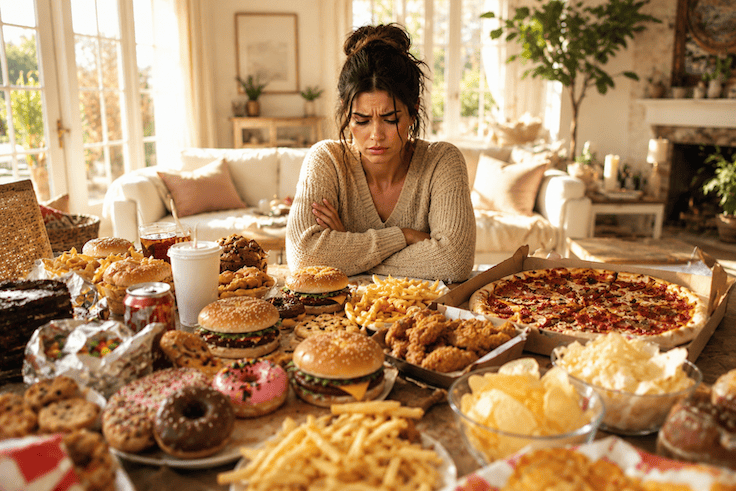
Pizza.
Desserts.
Chips.
Takeout.
Snack foods.
“Healthy” packaged foods that looked innocent enough.
And honestly? At first, I assumed the fasting would cancel everything out.
But over time, I started noticing something.
Even when I was fasting consistently, certain foods still made me feel awful.
Not immediately while eating them — that’s the tricky part.
It was afterward.
The bloating.
The puffiness around my face.
The swollen feeling around my waist.
The sluggish mornings.
The brain fog.
The strange anxiety.
The heaviness in my body.
I started realizing that fasting alone wasn’t the full picture.
What I was eating mattered just as much.
The Realization That Changed Everything
One of the biggest eye-openers for me was noticing how much of our food comes out of packages — even foods marketed as “healthy.”
And to be fair, packaged food itself is not automatically bad. Some packaged foods are minimally processed and can absolutely fit into a healthy lifestyle.
But many ultra-processed foods are engineered to last longer on shelves, improve texture, intensify flavor, or keep us coming back for more. That often means added preservatives, emulsifiers, flavor enhancers, industrial oils, gums, colorings, or highly refined ingredients.
Once I started reading ingredient labels more carefully, I realized how hard it was to avoid.
Even foods pretending to be wellness foods sometimes contained a long list of ingredients I barely recognized.
Protein bars.
Breakfast cereals.
Flavored yogurts.
Granola.
Low-fat snacks.
“Healthy” frozen meals.
Even certain breads and salad dressings.
It felt like ultra-processed ingredients had quietly slipped into almost everything.
And I started wondering:
How was my body actually responding to all of this?
What Changed When I Started Pulling Back
I want to be very clear:
I’m not a doctor, nutritionist, or health professional. This is simply my personal experience.
But little by little, as I reduced ultra-processed foods while also fasting more realistically, I noticed changes I couldn’t ignore.
I felt calmer.
Not euphoric.
Not magically transformed.
Just… calmer.
Less nervous.
Less overstimulated.
Less emotionally all over the place.
My energy felt steadier during the day instead of constantly crashing and recovering.
The bloating around my waist started improving.
My face looked less puffy in the mornings.
I felt more comfortable in my clothes again.
Even my skin started looking clearer.
And one of the strangest things?
My cravings became quieter.
Not gone completely — I still love food and still enjoy treats — but quieter.
That constant mental noise around food started easing up.
Fasting Worked Better Once I Changed What I Was Eating
This was the part I didn’t expect.
For a while, I treated fasting almost like a shield.
As long as I fasted long enough, I assumed I could eat whatever I wanted afterward and everything would balance itself out.
But for me personally, that didn’t really work long-term.
I eventually realized there’s a huge difference between:
- fasting while eating heavily ultra-processed foods
and - fasting while eating simpler, more whole foods most of the time.
Once I started eating:
- more protein
- bigger salads
- fruit
- rice
- eggs
- simple homemade meals
- less packaged snacking
…the fasting itself became easier.
I wasn’t fighting cravings as much.
I wasn’t waking up feeling swollen and exhausted.
And I didn’t feel trapped in the cycle of:
restrict → binge → regret → repeat.
The Weekend Cycle I Had to Face
If I’m being honest, weekends were always my weak spot.
Part of me felt entitled to binge because I had “earned it” during the week.
And sometimes I still indulge — I’m human.
But now I notice the difference almost immediately.
Too much ultra-processed food over a weekend and by Monday:
- my stomach feels off
- my rings feel tighter
- my sleep suffers
- my energy drops
- my focus gets foggy
- my cravings ramp back up
It’s much harder to ignore once you become aware of how your body actually feels.
The Biggest Change Wasn’t Weight
Yes, I felt less bloated.
Yes, my clothes fit more comfortably.
But honestly, the biggest difference was how I felt mentally.
Clearer.
Lighter.
More stable.
I didn’t realize how much certain foods were affecting my mood, focus, and overall sense of well-being until I started changing my habits little by little.
And no — I’m not perfect.
I still eat dessert sometimes.
I still have weekends where I overdo it.
I still love comfort foods.
But now I pay attention.
That awareness alone changed a lot for me.
Final Thoughts
I think many of us are trying to “out-fast” lifestyles that are quietly exhausting us.
We fast.
We count calories.
We try to stay disciplined.
But at the same time, we’re surrounded by foods designed to be hyper-palatable, ultra-convenient, and difficult to stop eating.
For me, the real shift happened when I stopped looking at fasting as the entire solution and started paying closer attention to the quality of the food I was eating too.
Not perfectly.
Not obsessively.
Just more consciously.
And surprisingly, those smaller changes ended up making the biggest difference.
Categorized in: